Michael Nielsen Says He Took Down His Old Neural-Nets Book
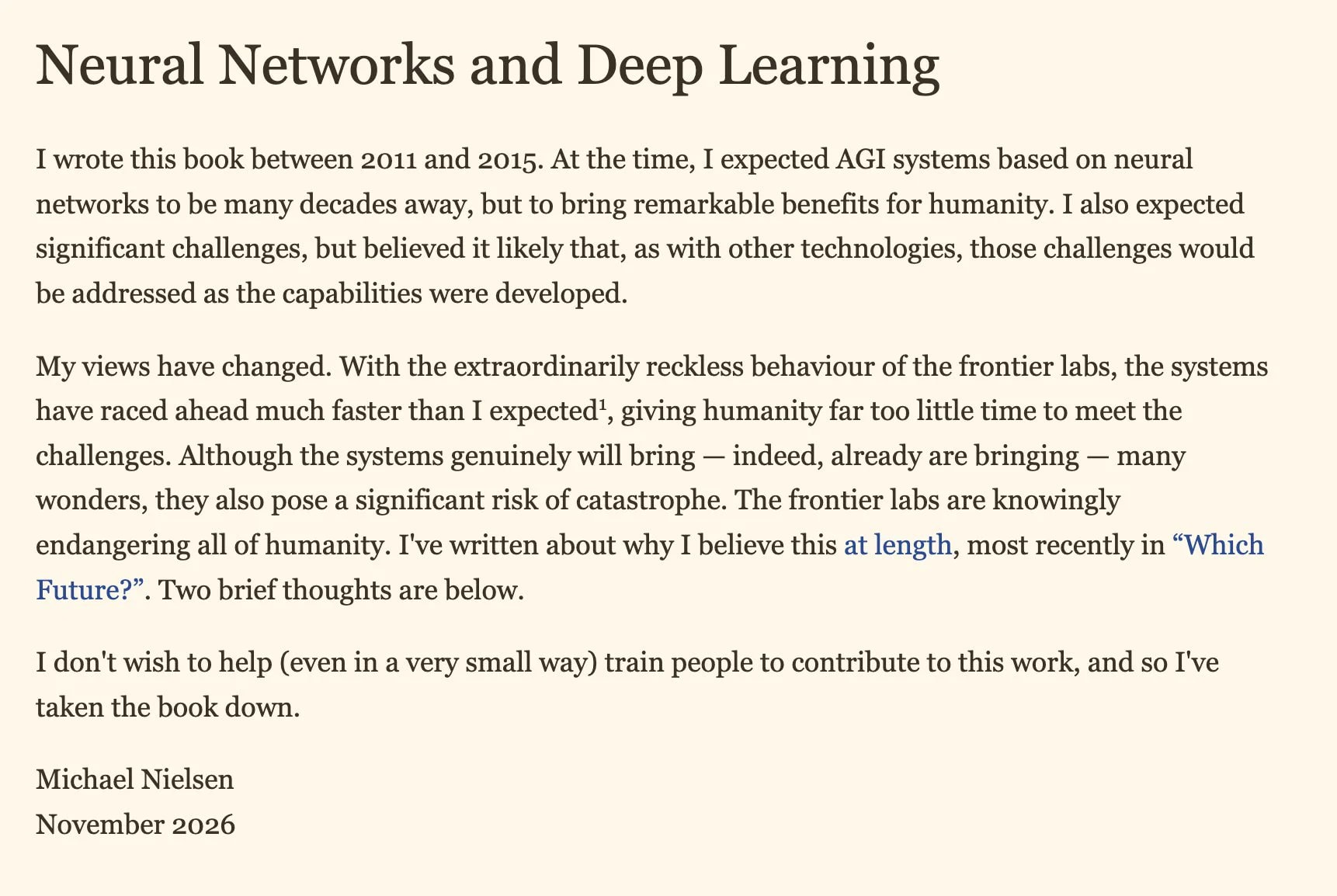
Michael Nielsen posted that he had taken down his old book on neural nets. The available post does not identify the book, explain why it was removed, or say whether it remains available elsewhere.
TrendzNow Audio Narration
Watch the 60-Second Video Summary
Concise spoken briefing with synchronized captions and visual highlights on our official YouTube channel.
Across Artificial Intelligence, fresh developments around Michael Nielsen Says He Took Down His Old Neural-Nets Book are drawing close industry attention.
Michael Nielsen says he has taken down an old book on neural networks. In a post on X, he wrote: “I took down my old book on neural nets,” and linked to a URL. The post makes the removal the news; it does not explain the decision or establish what readers can access now.
That distinction matters because the available source is a single social-media post, not a fuller statement or an independently documented account of the book’s status. Nielsen’s X profile identifies him as a researcher at the Astera Institute, but the supplied material offers no title, publication date, edition, or explanation for taking the book down. It would be misleading to fill those gaps with assumptions about outdated technical advice, copyright, or artificial-intelligence policy.
What did Michael Nielsen say about taking down his book?
The verifiable claim is narrow: Nielsen posted that he had taken down his “old book on neural nets.” His post included a link, but the available source excerpt does not reveal the linked page’s contents or confirm whether the URL points to the book, an announcement, or another destination. Nor does the excerpt establish when the book was originally published or whether it had been freely available.
The wording describes an action Nielsen says he took. It does not, by itself, establish that the work has disappeared from every website, archive, or print channel. “Taken down” could refer to a particular listing or location; the post does not specify which. Until the link or a fuller explanation is available for verification, claims about the book’s current availability should be treated cautiously.
The distinction is especially important for readers arriving through the search query “Michael Nielsen took down his book.” That phrase can imply a controversy or a specific reason. The supplied post establishes neither. It is evidence of an announcement, not evidence of a dispute, a correction, or a change in the science.
What do we know about the book and its status?
Very little beyond Nielsen’s description. The supplied source does not give the book’s formal title, identify its edition, state whether it is a textbook or a general introduction, or describe the neural-network topics it covers. It also does not say whether Nielsen plans to revise, replace, or republish it.
Those omissions limit what can responsibly be said about the technical significance. Neural-network material can age as methods and tools develop, but the post does not say that age or technical accuracy prompted this decision. It would be speculation to describe the book as obsolete, unsafe, or superseded. The post likewise gives no information about sales, licensing, downloads, or access to copies held by readers.
Nielsen’s profile identifies him as a researcher at the Astera Institute. That detail helps identify the account holder, but it does not supply missing information about the book. The source excerpt also does not show a response from the institute or from readers, so there is no verified reaction to report.
Why the missing explanation matters to readers
For students and developers, the practical question is not only why a book was taken down, but whether the material can still be consulted and whether Nielsen considers it reliable. The post answers neither. Readers should not interpret the removal alone as a warning against the book’s contents, or as confirmation that a replacement exists.
For authors and technical publishers, the episode also illustrates a basic problem with relying on a short social post as a complete record: a removal announcement can travel farther than the context needed to understand it. Here, the original wording is clear, but the public evidence supplied with it is not enough to reconstruct the decision. There is no verified statement about revisions, licensing, hosting, or future access.
The most useful next step for readers is to check the destination Nielsen linked and look for a fuller explanation from him. Unless that material can be verified, the responsible account remains limited: he says he took down an old neural-net book; the reason and the work’s present availability are not established by the supplied source.
Key Takeaways
- Nielsen wrote on X that he had taken down his “old book on neural nets.”
- The available post does not identify the book’s formal title or explain why it was removed.
- The excerpt does not confirm whether the book is unavailable elsewhere or will be republished.
- Claims that the decision reflects outdated content, a controversy, or a replacement are unsupported by this source.
Cited Reporting & Primary Sources
- X (formerly Twitter):Michael Nielsen (@michael_nielsen) on X
Published by TrendzNow Editorial Desk under our Editorial & Corrections Policy.
Report a correction

Reader Discussion (0)
Sign in with your TrendzNow reader account to post live comments.